ON THIS PAGE
Many people who carry the herpes simplex virus feel completely healthy. They've never noticed a sore, and have no reason to think anything is wrong. Yet the virus can still be active on the skin, shed quietly and pass to a partner. This guide explains herpes simplex virus type 2 (HSV-2), the main cause of genital herpes: how it spreads, what it does over time, when testing helps and how it's treated. Ovio's herpes test is done at home in Bangkok.
How Common Is HSV-2?
The World Health Organization estimates that about 520 million people aged 15 to 49, or 13%, have HSV-2. It's common in Thailand and across Southeast Asia too, and as everywhere, most infections are never diagnosed because they cause mild symptoms or none.
What Is HSV-2 and How Does It Affect the Body?
HSV-2 is a DNA virus in the herpes family, closely related to HSV-1, the usual cause of cold sores. It prefers the skin and lining of the genitals and anus. Its life in the body has four stages:
First infection: the virus enters through genital or anal skin during sex and multiplies in skin cells. This may cause a first outbreak, or nothing noticeable at all.
Latency: the virus travels up a nerve to a nerve cluster near the base of the spine (the sacral ganglia) and lies dormant. The immune system keeps it in check but can't remove it, which is why HSV-2 is lifelong.
Reactivation: from time to time the virus travels back down the nerve to the skin. This can happen without any sign, so-called shedding.
Recurrent outbreaks: sometimes reactivation causes sores again, usually in the same area, often after a warning tingle. Recurrences are typically shorter and milder than the first episode and tend to become less frequent over the years.
HSV-1 vs HSV-2: What's the Difference?
| HSV-1 | HSV-2 | |
|---|---|---|
| Usual site | Mouth and lips (cold sores); increasingly the genitals | Genitals and anus |
| How it's spread | Kissing and close contact, often in childhood; oral sex | Almost always sex: vaginal, anal or oral, or genital skin contact |
| Genital recurrences | Usually fewer | Usually more frequent |
| Mouth infection | Common | Uncommon |
So a diagnosis of genital herpes can be either type. Knowing which matters, because genital HSV-2 is more likely to keep coming back. For cold sores and genital HSV-1, see what is HSV-1?
How Is HSV-2 Transmitted?
- Sex: vaginal and anal sex, and genital skin-to-skin contact without penetration. Oral sex on a partner with genital HSV-2 can occasionally pass it to the mouth.
- Shedding without symptoms: the virus can be released from skin that looks normal. Most people catch HSV-2 from a partner who has no sores at the time and often doesn't know they're infected.
- From mother to baby during birth, mainly when the mother caught herpes late in pregnancy.
Condoms lower the risk but don't remove it, because the virus can be shed from skin they don't cover. HSV-2 isn't caught from toilet seats, towels or swimming pools.
HSV-2 Symptoms
Symptoms vary a lot. Many people's are so mild they mistake them for chafing, razor burn, an ingrown hair or thrush. When an outbreak is obvious, it usually brings:
- Tingling, itching or burning in the area before anything shows.
- Small, fluid-filled blisters, often in a cluster, which break into shallow, painful sores and then crust over and heal.
- Pain when urine passes over the sores.
- With a first outbreak, often fever, aches, tiredness and tender, swollen glands in the groin.
In men, sores can appear on the penis, scrotum, around the anus, on the buttocks or inner thighs. In women, they can appear on the vulva, inside the vagina, on the cervix, between the vagina and anus, on the buttocks or inner thighs. Sores on the cervix or inside the vagina are often painless and go unnoticed.
If a first infection causes symptoms, they usually appear 2 to 12 days after contact. But a first outbreak can also appear months or years later, the first time the virus reactivates, so a new outbreak doesn't necessarily mean a partner has been unfaithful.
What Can Trigger an HSV-2 Outbreak?
People with recurrences often notice outbreaks after:
- Stress, or physical exhaustion and poor sleep
- Another illness, such as a cold, flu or fever
- Their period
- Friction or injury to the skin, for example from vigorous sex, shaving or a procedure in the area
Outbreaks can also happen with no obvious trigger. How often someone has them varies widely and says nothing about their general health.
HSV-2 Complications
- HIV risk: genital sores and inflammation make it easier to catch HIV. WHO says people with HSV-2 are about three times more likely to acquire HIV. See what is HIV?
- Meningitis: rarely, HSV-2 causes meningitis, with a severe headache, stiff neck and sensitivity to light, which needs urgent care. In some people it recurs.
- Severe or spreading infection in people with a weakened immune system.
- Neonatal herpes: a newborn can be seriously ill if infected during birth (see pregnancy below).
- Emotional impact: anxiety, shame and worry about telling partners are often harder than the physical symptoms. Herpes is common and manageable, and talking to a doctor helps.
HSV-2 in Pregnancy
The main risk is catching genital herpes for the first time late in pregnancy, before the mother has made antibodies that protect the baby. Women who had herpes before pregnancy pass on antibodies, so their baby's risk is low. If you or a partner have herpes and you're pregnant, tell your doctor or midwife: antiviral tablets are usually offered in the last weeks, and a caesarean is advised only if there are sores or warning symptoms when labour starts. If your partner has herpes and you don't, avoid sex in the third trimester or use condoms every time.
HSV-2 Window Period and Testing
| PCR swab | Type-specific IgG blood test | |
|---|---|---|
| What it detects | The virus's DNA, HSV-1 or HSV-2 | Antibodies to HSV-1 and HSV-2 |
| Sample | Swab of a blister or sore | Blood from a vein |
| When to use it | While a sore is present, ideally in the first few days | No sore, in situations a doctor agrees on |
| Timing after exposure | As soon as a sore appears | 12 to 16 weeks, as antibodies can take up to 12 weeks |
| Limits | A healing or crusted sore may test negative | Can't show where or when; low positive HSV-2 results can be false |
A swab works whenever there's a sore, however recent the exposure. A blood test taken too soon can be negative simply because antibodies haven't appeared yet; if so, repeat it later. Viral culture, an older swab test, is less sensitive than PCR once sores start to dry. IgM blood tests and older non-type-specific antibody tests aren't recommended.
Can HSV-2 Be Cured?
No medicine can yet remove HSV-2 from the nerves, but antivirals keep it well controlled, and most people with HSV-2 live normal lives and relationships.
- Antiviral tablets: aciclovir, valaciclovir and famciclovir. A first outbreak is usually treated for 7 to 10 days.
- Treating each outbreak (episodic treatment): a short course of one to five days, depending on the medicine, started at the first tingle, shortens the outbreak.
- Daily (suppressive) treatment: a daily dose prevents most outbreaks and lowers the chance of passing HSV-2 to a partner. It suits people with frequent outbreaks, or whose partner doesn't have herpes.
How to Lower the Risk of Passing On HSV-2
- Avoid sex during an outbreak and when you feel the warning tingle.
- Use condoms every time; they lower the risk though they don't cover all the skin.
- Consider daily antivirals if your partner doesn't have herpes.
- Tell partners. Most HSV-2 spreads without symptoms, so knowing lets you both choose how to manage the risk.
Genital Herpes Testing in Bangkok
The most useful time to see a doctor is while a sore is fresh. People often wait out of embarrassment until it heals, when a swab is far less likely to give an answer. A genital sore can also be syphilis, so a syphilis blood test is usually added, and because HSV-2 raises the HIV risk, an HIV test at the same time is sensible.
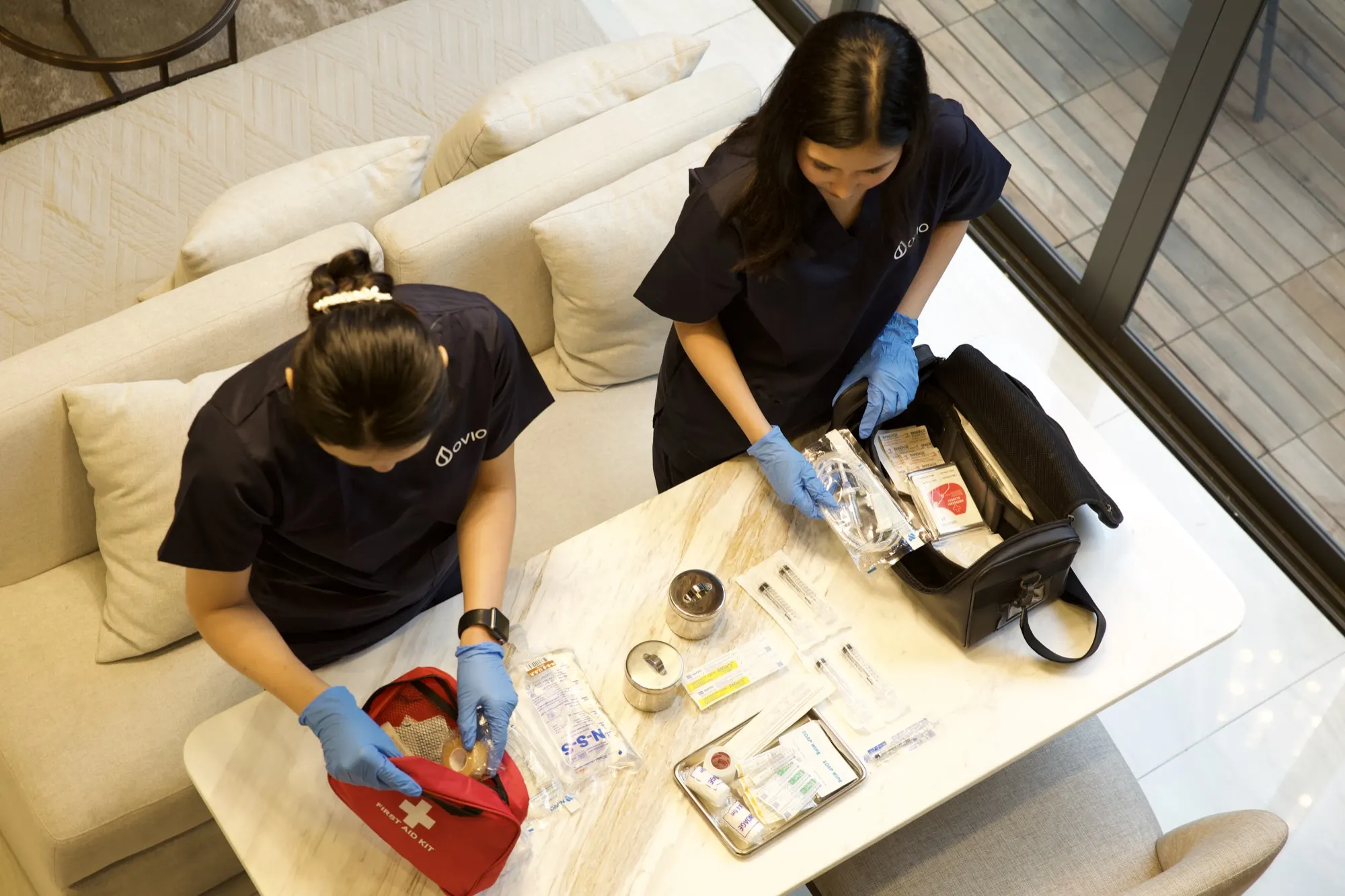
With Ovio's at-home STI testing, a doctor visits your home, condo, hotel or office anywhere in Bangkok at a time you choose, for Thai and international clients. The herpes lesion-swab PCR (HSV-1 and HSV-2) is ฿3,990, and the HSV-1 and HSV-2 type-specific IgG blood test is ฿3,490. If your timing is uncertain, the STI test window calculator shows when other tests become reliable. Not sure what else to test for? See which STI tests should I get?
Private STI testing in Bangkok
Ovio can arrange private STI testing at a location that works for you.
Frequently Asked Questions
Can I have HSV-2 without symptoms?
Yes. Most people with HSV-2 don't know they have it, either because they've never had symptoms or because they were too mild to notice. They can still pass it on.
I've been with my partner for years. Why do I have herpes now?
A first outbreak can appear months or years after infection, and either of you may have carried the virus without symptoms. A new diagnosis doesn't prove recent infection or unfaithfulness.
How often will outbreaks come back?
It varies. Genital HSV-2 recurs more often than genital HSV-1, and recurrences are usually most frequent in the first year, then become milder and less frequent. Daily antivirals prevent most of them.
Is HSV-2 tested in a standard STI check?
Usually not, because routine HSV-2 blood tests aren't recommended without symptoms. Ask for a herpes test if you have a sore, or if a partner has herpes.
Can I still have sex and relationships with HSV-2?
Yes. Avoiding sex during outbreaks, using condoms and taking daily antivirals together cut the risk to a partner a great deal.
Sources
ABOUT THIS GUIDE
This guide gives general information and is not personal medical advice.
- Written by
- Kewalee Rujikajorn
- Published