ON THIS PAGE
Syphilis is a sexually transmitted infection (STI) caused by the bacterium Treponema pallidum. Unlike HIV or herpes, it's completely curable with antibiotics. The difficulty is noticing it: the early signs are often painless or hidden, and they go away by themselves. This guide explains what syphilis is, how it develops, what testing involves and how treatment and prevention work. Ovio's syphilis test is done at home in Bangkok.
What Is Syphilis?
Treponema pallidum is a tiny, corkscrew-shaped bacterium. It enters the body through the moist lining of the genitals, anus or mouth, or through small breaks in the skin, and then spreads through the bloodstream. That's why syphilis is described as a systemic infection: it can affect almost any part of the body.
Many people with syphilis feel completely well. They can have no symptoms for months or years, and in the early stages they can still pass it on.
How Common Is Syphilis?
Syphilis isn't a disease of the past. The World Health Organization estimates that 8 million adults aged 15 to 49 acquired syphilis worldwide in 2022. Reported cases in Thailand have also risen sharply in recent years. Our STI statistics for Thailand report shows the latest figures from the Department of Disease Control.
How Does Syphilis Spread?
Syphilis spreads through direct contact with a syphilis sore (a chancre) or with the rash or moist patches of secondary syphilis. Ejaculation isn't needed: skin or mucous membrane contact is enough. The main routes are:
- Vaginal sex
- Anal sex
- Oral sex, in either direction. A sore in the mouth or on the lips can pass it to the genitals, and the other way round. See STIs from oral sex.
- Close skin-to-skin contact with a sore or rash during sex.
- From mother to baby through the placenta during pregnancy, which is called congenital syphilis.
How syphilis is not spread
The bacterium doesn't survive long outside the body, so you can't catch syphilis from toilet seats, door handles, swimming pools, towels, clothes, cutlery or glasses, or from hugging, shaking hands or sharing food.
The 4 Stages of Syphilis and Their Symptoms
| Stage | When | Main signs |
|---|---|---|
| Primary | 10 to 90 days after exposure (about 3 weeks on average) | One or more firm, painless sores (chancres) |
| Secondary | Weeks to a few months later | A non-itchy rash, often on the palms and soles; fever, swollen glands |
| Latent | After secondary signs fade, for years | No symptoms; found only by a blood test |
| Tertiary | 10 to 30 years after infection, if untreated | Damage to the heart, blood vessels, brain and nerves |
1. Primary syphilis
The first sign is usually a chancre: a firm, round, usually painless sore where the bacteria got in. That can be the penis, vulva, vagina, cervix, anus, rectum, lips or mouth. There may be more than one. The sore heals by itself in 3 to 6 weeks, with or without treatment. Because it doesn't hurt and is often out of sight, many people never notice it. A healed sore doesn't mean the infection has gone.
2. Secondary syphilis
Without treatment, the bacteria spread through the body. Secondary syphilis can bring:
- A rash that usually doesn't itch, classically on the palms of the hands and soles of the feet, though it can appear anywhere.
- Moist, wart-like patches (condylomata lata) in warm areas such as the groin, and sores in the mouth.
- Fever, swollen glands, sore throat, patchy hair loss, muscle aches and tiredness.
These symptoms also clear up without treatment, but the infection stays.
3. Latent syphilis
In the latent stage there are no signs or symptoms at all. It can only be found with a blood test. CDC divides it into early latent syphilis, caught within the past 12 months, and late latent syphilis, caught more than 12 months ago or at an unknown time. Early latent syphilis can still be passed on, because secondary symptoms can come back.
4. Tertiary syphilis
Tertiary syphilis is rare now, but in a minority of untreated people it develops 10 to 30 years after infection. It can damage the heart and blood vessels, the brain and nerves, the eyes, and the bones and joints, and it can cause destructive lumps called gummas. This damage often can't be reversed, and it can be fatal. Treating syphilis early prevents it.
Syphilis Symptoms in Men and Women
The stages are the same for everyone. What differs is where the first sore tends to appear, and how easy it is to spot.
- Men: the chancre is often on the shaft or head of the penis or the foreskin, and the glands in the groin may swell. After anal or oral sex, it can be in or around the anus, inside the rectum, or in the mouth, where it's easily missed.
- Women: sores can be on the vulva or labia, but they're often inside the vagina or on the cervix, where they can't be seen or felt without an examination. Sores around the anus or in the mouth are also possible.
In both, the secondary rash on the palms and soles is the most recognisable sign. And in both, the first stage, when syphilis is most easily passed on, often goes unnoticed. That's why testing matters even without symptoms: see STIs without symptoms.
Syphilis Complications
Untreated syphilis can spread to specific parts of the body. Some of these complications can happen at any stage, including the first months:
- Neurosyphilis: infection of the brain and spinal cord. It can cause headaches, changes in behaviour, weakness, poor coordination and, later, dementia.
- Ocular syphilis: infection of the eye, with redness, pain, blurred vision and, if untreated, permanent loss of sight.
- Otosyphilis: infection of the inner ear, with hearing loss, ringing in the ears (tinnitus) and dizziness.
- Cardiovascular syphilis: damage to the aorta and heart valves, years after infection.
- Congenital syphilis: passed to a baby during pregnancy, it can cause miscarriage, stillbirth, premature birth, low birth weight or serious illness in the newborn.
How Is Syphilis Diagnosed?
Syphilis is diagnosed with blood tests. Two kinds are used together. Our guide to RPR vs VDRL vs TPPA explains them in more detail.
- Non-treponemal tests (RPR or VDRL): these measure a reaction to the infection rather than the bacterium itself. The level, called the titre, rises with active infection and falls after treatment, so it's also used to check that treatment worked. They can occasionally be positive for other reasons, such as pregnancy, autoimmune conditions or some other infections, which is why a positive result is always confirmed.
- Treponemal tests (TPHA, TPPA, FTA-ABS or immunoassays): these detect antibodies specific to Treponema pallidum. They're very accurate, but they usually stay positive for life, even after a cure.
If both types are reactive, you have syphilis now or have had it in the past. Whether it's active is judged from your history, any previous treatment and the RPR titre, compared with earlier results if you have them. If there's an open sore, a doctor may also swab it, which can pick up very early infection before the blood tests turn positive.
When to test
Blood tests can take time to turn positive after an exposure. NHS services use 12 weeks after the exposure as the point for a final test. If you test earlier and the result is negative, you may need to repeat it. Don't wait, though, if you have a sore or a rash, or a partner has been diagnosed: see a doctor straight away, because you may be treated before your own test turns positive. Work out your own dates with the STI test window calculator.
Test regularly if you have new or multiple partners. Men who have sex with men are usually advised to test every 3 to 6 months, as are people living with HIV or taking PrEP. Everyone who is pregnant should be tested.
Syphilis Treatment
- Early syphilis (primary, secondary or early latent): a single injection of benzathine penicillin into a muscle is the standard cure recommended by WHO and CDC.
- Late latent syphilis, or syphilis of unknown duration: three injections, one a week for three weeks.
- Neurosyphilis, ocular syphilis and otosyphilis: penicillin through a drip in hospital, usually for 10 to 14 days.
- Penicillin allergy: people who aren't pregnant may be given another antibiotic, such as a course of doxycycline tablets, under medical supervision. In pregnancy, penicillin is the only recommended treatment, so a pregnant person with an allergy is usually desensitised to it in hospital.
Some people get a fever, chills, headache and aches within a day of their first dose. This is the Jarisch-Herxheimer reaction, caused by the bacteria dying off. It usually passes within 24 hours, but it's worth knowing about in advance.
Avoid sex until your treatment is complete and any sores have healed. Partners from the last 90 days should be treated even if their own test is negative, because early infection may not show yet. Partners from further back should be tested. Our guide on what to do if a partner tests positive covers this.
Follow-up RPR blood tests, usually at 6 and 12 months, show whether treatment has worked: a falling titre is the sign of a cure. See STI retesting after treatment. Being cured doesn't make you immune, so you can catch syphilis again.
How to Prevent Syphilis
- Use condoms and dental dams for vaginal, anal and oral sex. They lower the risk a lot.
- Know their limits. Condoms only protect the skin they cover. A sore on the scrotum, inner thigh or pubic area can still pass syphilis on.
- Test regularly, and ask new partners to test too.
- Tell recent partners if you're diagnosed, so they can be tested and treated.
- Test in pregnancy, early and as advised later on, to protect the baby.
Syphilis Testing in Bangkok
Syphilis testing is available at hospitals and sexual health clinics across Bangkok, and it's part of routine antenatal care in Thailand.
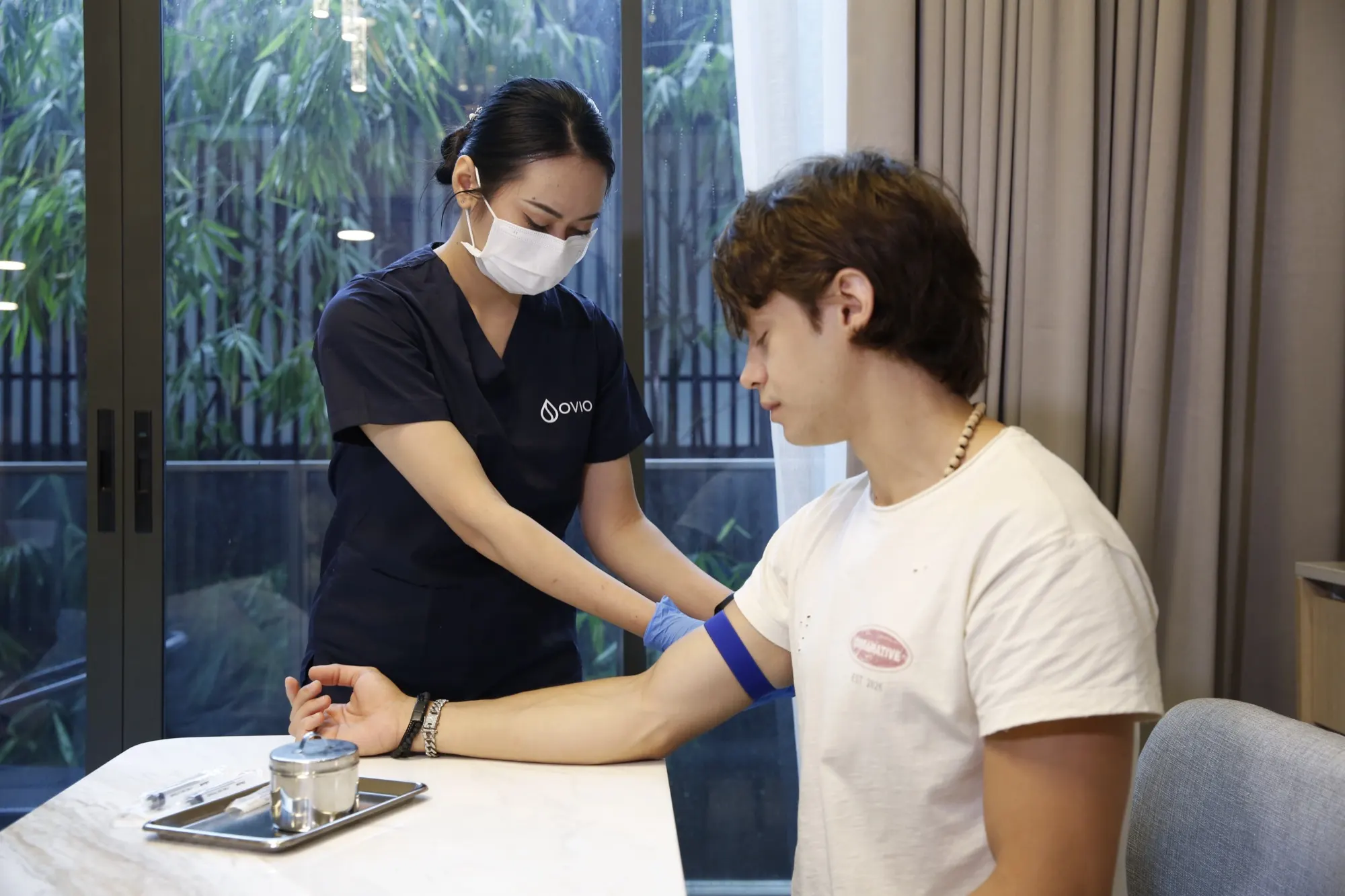
If you'd prefer private testing, Ovio's at-home STI testing brings a doctor to your home, condo, hotel or office at a time you choose. The syphilis test uses the same blood tests described above: VDRL/RPR screening is ฿890 and the TPHA/TPPA antibody test is ฿1,290. Syphilis screening is also included in the Ovio Essential package (฿5,990), with HIV, hepatitis B and C and an 18-infection PCR panel. Not sure what else to test for? See which STI tests should I get?
Private STI testing in Bangkok
Ovio can arrange private STI testing at a location that works for you.
Frequently Asked Questions
Can syphilis go away on its own?
The symptoms can, but the infection doesn't. The first sore and the secondary rash both heal without treatment, and syphilis then becomes latent. It needs antibiotics to cure it.
Is syphilis curable?
Yes. Penicillin cures syphilis at every stage, usually with a single injection for early infection. Damage done before treatment, for example to the eyes or nerves, may not fully recover, which is why early testing matters.
Can you get syphilis from oral sex?
Yes. Contact between the mouth and a sore on the genitals or anus, or between a sore in the mouth and the genitals, can pass it on. Ejaculation isn't needed.
How long after sex should I test for syphilis?
A blood test 12 weeks after the exposure gives a final answer. You can test earlier, but a negative result may need repeating. If you have a sore or rash, or a partner has syphilis, see a doctor now rather than waiting.
Will my syphilis test stay positive after treatment?
Usually one of them will. The treponemal test (TPHA or TPPA) normally stays positive for life. The RPR titre should fall after treatment, and that's what doctors use to confirm a cure and spot a new infection.
Sources
ABOUT THIS GUIDE
This guide gives general information and is not personal medical advice.
- Written by
- Kewalee Rujikajorn
- Published