ON THIS PAGE
Syphilis is a common sexually transmitted infection (STI), and cases in Thailand have risen sharply in recent years. It's diagnosed with a blood test, but a syphilis result often lists more than one test: RPR, VDRL, TPPA or TPHA. They aren't interchangeable. Knowing what each one measures explains why you might be positive on one and negative on another, and why one result can stay positive after you've been cured. If you need a test, Ovio's syphilis test is done at home in Bangkok.
The RPR Syphilis Test
RPR (rapid plasma reagin) is the most widely used syphilis screening test. It's a non-treponemal test: rather than looking for the bacterium, it detects antibodies the body makes against material released from cells damaged by the infection. These antibodies rise while syphilis is active and fall after successful treatment.
The test uses tiny charcoal particles, so a reaction can be seen with the naked eye. A reactive sample is diluted step by step, and the result is reported as a titre: 1:2, 1:4, 1:8, 1:16 and so on. The higher the second number, the more antibody there is. RPR is used to screen, to support a diagnosis, to check that treatment has worked, and to spot reinfection.
A titre doesn't tell you how many bacteria are in your body, and a single result can't show the stage of syphilis or whether treatment worked. What matters is how the titre changes over time, compared on the same type of test.
The VDRL Syphilis Test
VDRL (Venereal Disease Research Laboratory) works on the same principle as RPR and is also non-treponemal. The main practical difference is that VDRL is read under a microscope, so it's more manual. Its titres follow the same pattern as RPR: high with active infection, falling after treatment.
RPR and VDRL titres can't be compared directly with each other, because RPR titres often run slightly higher. If you're being followed up, it's best to stay on the same test, ideally at the same laboratory. VDRL is also the test used on spinal fluid when a doctor suspects syphilis has affected the nervous system.
The TPPA (and TPHA) Syphilis Test
TPPA (Treponema pallidum particle agglutination) is a treponemal test. It uses particles coated with proteins from Treponema pallidum, the bacterium that causes syphilis, and detects antibodies made specifically against it. TPHA works the same way and is used interchangeably by many labs; immunoassays (EIA or CLIA) are another kind of treponemal test.
Treponemal tests are very accurate at showing whether someone has ever had syphilis. But once you've had it, the result usually stays positive for life, even after a complete cure. So TPPA on its own can't tell an old, treated infection from a new or active one, and it isn't used to check whether treatment worked.
RPR vs VDRL vs TPPA: The Differences at a Glance
| RPR | VDRL | TPPA / TPHA | |
|---|---|---|---|
| Full name | Rapid plasma reagin | Venereal Disease Research Laboratory | Treponema pallidum particle (or haem) agglutination |
| Test type | Non-treponemal | Non-treponemal | Treponemal |
| What it detects | Antibodies to material from cells damaged by the infection | The same as RPR | Antibodies to the syphilis bacterium itself |
| Result | A titre, such as 1:8 | A titre, such as 1:8 | Reactive or non-reactive |
| Used for | Screening, judging activity, checking treatment, spotting reinfection | The same as RPR; also spinal fluid testing | Confirming syphilis, past or present |
| How it's read | Charcoal particles, visible to the naked eye | Under a microscope | Particle clumping in a test well |
| After a cure | Titre falls, often to non-reactive | Titre falls, often to non-reactive | Usually stays positive for life |
Why Doctors Use Both Types of Test
Neither type of test is enough on its own. A diagnosis of syphilis needs a positive result on both a non-treponemal test (RPR or VDRL) and a treponemal test (TPPA, TPHA or an immunoassay), read alongside your symptoms, sexual history and any past treatment.
Labs can run them in either order. Many start with RPR and confirm a reactive result with TPPA. Others start with a treponemal immunoassay and then run RPR; if the two disagree, a second treponemal test such as TPPA settles it. Read together, the results usually point to one of these:
| RPR / VDRL | TPPA / TPHA | Usual meaning |
|---|---|---|
| Non-reactive | Non-reactive | No sign of syphilis, unless exposure was very recent |
| Reactive | Reactive | Syphilis now, or a past infection; the titre and history decide which |
| Non-reactive | Reactive | Syphilis treated in the past, or a very early or old untreated infection |
| Reactive | Non-reactive | Usually a false positive RPR; may need repeating |
What RPR and VDRL Show After Treatment
After treatment, the RPR or VDRL titre is the number to watch. For early syphilis it's usually repeated 6 and 12 months after treatment (more often for people living with HIV). A fourfold fall, two steps down, such as 1:32 to 1:8, shows the treatment is working. A change of one step, such as 1:8 to 1:4, is within normal test variation.
Many people become non-reactive over time. Some keep a low titre, such as 1:1 or 1:2, for years after a successful cure; this is called being serofast and doesn't mean the infection is still there. A fourfold rise after treatment, on the other hand, suggests reinfection or treatment failure, and needs a doctor's review. For timings across all STIs, see STI retesting after treatment.
Understanding Positive and Negative Results
A positive (reactive) RPR or VDRL
A reactive result can mean a current infection, a past infection that's still settling after treatment, or occasionally a false positive. It doesn't by itself prove that syphilis is active or that treatment failed. Your doctor reads it with the titre, a treponemal test, earlier results and your history.
A negative (non-reactive) RPR or VDRL
A non-reactive result means no antibodies were found. It doesn't always rule syphilis out: in the first weeks after infection, the body may not yet have made enough antibodies to detect. If the exposure was recent, or there's a sore, your doctor may repeat the test in 2 to 4 weeks, and syphilis blood tests are reliable by 12 weeks after exposure. If a partner has been diagnosed, see a doctor straight away: you may be treated before your own test turns positive. The STI window periods guide has the timings.
Getting a Syphilis Blood Test in Bangkok
If you've had sex that may have put you at risk, have a painless sore or an unexplained rash, or a partner has syphilis, a blood test will show where you stand. Syphilis is curable with antibiotics, and testing early prevents complications and protects your partners.
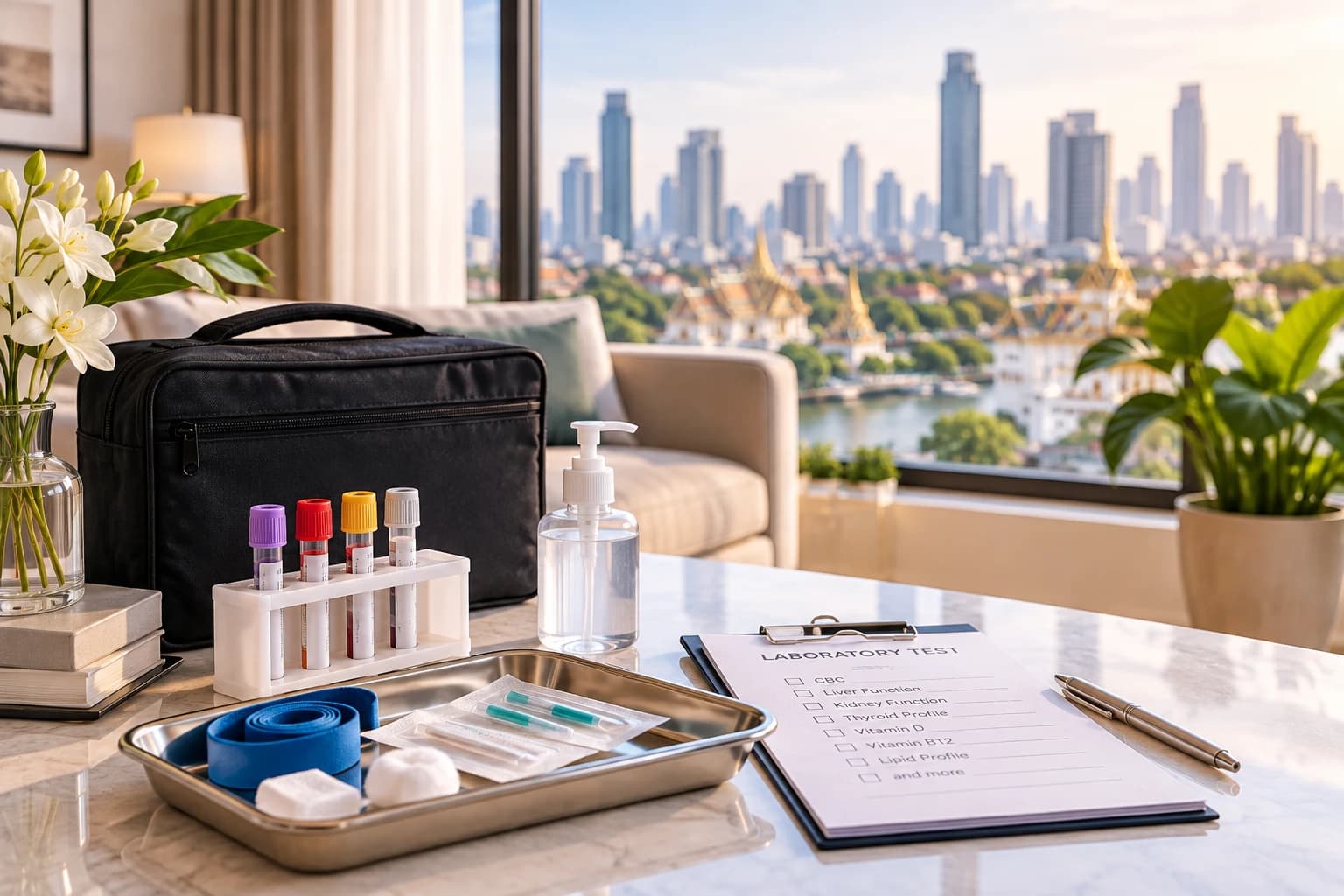
Ovio's at-home STI testing brings the test to your home, condo, hotel or office anywhere in Bangkok, for Thai and international clients. Syphilis screening (VDRL/RPR) is ฿890 and the TPHA/TPPA antibody test is ฿1,290; syphilis screening is also part of every STI package. Results are reliable and handled confidentially. If you're unsure which tests you need, see which STI tests should I get?
Private STI testing in Bangkok
Ovio can arrange private STI testing at a location that works for you.
Frequently Asked Questions
Is RPR or VDRL more accurate?
They're very similar. RPR is quicker and easier to run, so it's more common for blood. VDRL is used on spinal fluid. The important thing is to stay on the same test for follow-up, because their titres aren't directly comparable.
What does an RPR titre of 1:8 mean?
It means the sample was still reactive after being diluted eight times. On its own it can't show whether syphilis is active; your doctor compares it with a treponemal test, earlier titres and your history. After treatment, a fall to 1:2 or lower would be a fourfold drop.
Why is my TPPA still positive after treatment?
Because treponemal antibodies usually stay for life after syphilis, even when it's cured. That's expected. The RPR or VDRL titre is what shows whether the treatment worked.
Can I get syphilis again if my TPPA is positive?
Yes. A positive TPPA doesn't mean you're immune. If you're exposed again, a rising RPR titre is how a new infection is found, which is why people with a past infection keep having RPR tests.
How soon after sex can a syphilis blood test detect infection?
Often within a few weeks, but not always. Syphilis blood tests are considered reliable by 12 weeks after exposure, so an earlier negative test may need repeating.
Sources
ABOUT THIS GUIDE
This guide gives general information and is not personal medical advice.
- Written by
- Kewalee Rujikajorn
- Published